

# init repo notebook
!git clone https://github.com/rramosp/ppdl.git > /dev/null 2> /dev/null
!mv -n ppdl/content/init.py ppdl/content/local . 2> /dev/null
!pip install -r ppdl/content/requirements.txt > /dev/null
High level models with Keras#
import numpy as np
import tensorflow as tf
import matplotlib.pyplot as plt
import pandas as pd
%matplotlib inline
%load_ext tensorboard

from sklearn.datasets import *
from local.lib import mlutils
from IPython.display import Image
tf.__version__
Implementing linear regresion in TF#
d = pd.read_csv("local/data/trilotropicos.csv")
y = d.densidad_escamas.values.astype(np.float32)
X = np.r_[[d.longitud.values]].T.astype(np.float32)

print(X.shape, y.shape)
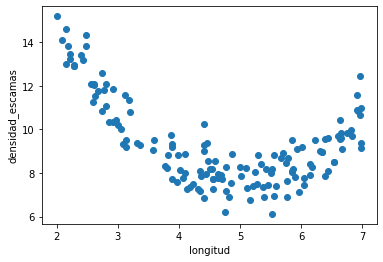
plt.scatter(d.longitud, d.densidad_escamas)
plt.xlabel(d.columns[0])
plt.ylabel(d.columns[1]);
(150, 1) (150,)
from sklearn.linear_model import LinearRegression

lr = LinearRegression()
lr.fit(X,y)
lr.coef_, lr.intercept_
(array([-0.71805906], dtype=float32), 12.689999)
Version 1: packing up with Keras class API and custom SGD#
observe:
the
buildmethod that is called by Keras wheneverinput_shapeis knownwe use
add_weightso that our model weights are known to the Keras model framework (trainable_variables,get_weights, etc.)
see here
class LinearRegressionModel4(tf.keras.Model):

    def build(self, input_shape):
        self.w = self.add_weight(shape=(input_shape[-1], 1), initializer='random_normal',
                                 trainable=True, dtype=tf.float32)

        self.b = self.add_weight(shape=(1,), initializer='random_normal',
                                 trainable=True, dtype=tf.float32)

    def call(self, inputs):
        return tf.matmul(inputs, self.w) + self.b

    @tf.function
    def get_gradient(self, X, y):
        with tf.GradientTape() as t:
            loss = tf.reduce_mean( (self(X)-y)**2)

        gw, gb = t.gradient(loss, [self.w, self.b])
        return gw, gb, loss

    def fit(self, X,y, epochs, batch_size=16, learning_rate=0.01):
        y = y.reshape(-1,1)
        self.h=[]
        for epoch in pbar(range(epochs)):
            idxs = np.random.permutation(len(X))
            for step in range(len(X)//batch_size+((len(X)%batch_size)!=0)):
                X_batch = X[idxs][step*batch_size:(step+1)*batch_size]
                y_batch = y[idxs][step*batch_size:(step+1)*batch_size]

                gw, gb, loss = self.get_gradient(X_batch,y_batch)
                self.w.assign_sub(learning_rate * gw)
                self.b.assign_sub(learning_rate * gb)
                self.h.append([gw.numpy()[0][0], gb.numpy()[0], w.numpy()[0][0], b.numpy()[0], loss.numpy()])
        self.h = np.r_[self.h]
model = LinearRegressionModel4()
observe that we can use the object directly on data to get predictions
model(X[:2])
<tf.Tensor: shape=(2, 1), dtype=float32, numpy=
array([[-0.04066426],
       [-0.04316743]], dtype=float32)>
or with the .predict method
model.predict(X[:2])
array([[-0.04066426],
       [-0.04316743]], dtype=float32)
model.trainable_variables
[<tf.Variable 'linear_regression_model4/Variable:0' shape=(1, 1) dtype=float32, numpy=array([[0.00150557]], dtype=float32)>,
 <tf.Variable 'linear_regression_model4/Variable:0' shape=(1,) dtype=float32, numpy=array([-0.0464113], dtype=float32)>]
model.get_weights()
[array([[0.00150557]], dtype=float32), array([-0.0464113], dtype=float32)]
and fit the model
model.fit(X, y, epochs=400, batch_size=16)
100% (400 of 400) |######################| Elapsed Time: 0:00:02 Time: 0:00:02
model.b.numpy(), model.w.numpy()
(array([12.6924925], dtype=float32), array([[-0.5818763]], dtype=float32))
predictions = model(X)

rmse = tf.reduce_mean((predictions-y)**2).numpy()
plt.figure(figsize=(15,2));
plt.plot(model.h[:,-1]); plt.xlabel("step number"); plt.ylabel("loss"); plt.grid();
plt.title("RMSE %.3f"%rmse);
plt.ylim(0,50)
(0.0, 50.0)

Version 2: Sequential Keras model with standard loop#
from tensorflow.keras import Sequential
from tensorflow.keras.layers import Dense

def get_model5():
    model = Sequential()
    model.add(Dense(1, input_shape=(X.shape[-1],), activation="linear"))
    model.compile(optimizer=tf.keras.optimizers.SGD(learning_rate=0.01),
                  metrics=["mean_absolute_error"],
                  loss="mse")
# equivalent forms for loss
#                  loss = lambda y_true, y_pred: tf.reduce_mean((y_true-y_pred)**2))
#                  loss="mean_squared_error")
#                  loss=tf.keras.metrics.mean_squared_error)
    return model
from sklearn.model_selection import train_test_split
X_train, X_val, y_train, y_val = train_test_split(X,y.reshape(-1,1), test_size=0.2)
X_train.shape, X_val.shape, y_train.shape, y_val.shape
((120, 1), (30, 1), (120, 1), (30, 1))
!rm -rf logs
model = get_model5()

tb_callback = tf.keras.callbacks.TensorBoard('./logs', update_freq=1)
model.fit(X_train,y_train, epochs=100, batch_size=5, verbose=0,
          callbacks=[tb_callback], validation_data=(X_val, y_val))

model.weights
[<tf.Variable 'dense_12/kernel:0' shape=(1, 1) dtype=float32, numpy=array([[-0.5444805]], dtype=float32)>,
 <tf.Variable 'dense_12/bias:0' shape=(1,) dtype=float32, numpy=array([11.90973], dtype=float32)>]
history is now logged only per epoch
model.history.history.keys()
dict_keys(['loss', 'mean_absolute_error', 'val_loss', 'val_mean_absolute_error'])
predictions = model(X)
rmse = np.mean((predictions-y)**2)

plt.figure(figsize=(15,2));
plt.plot(model.history.history["val_loss"], label="val");
plt.plot(model.history.history["loss"], label="train");
plt.xlabel("step number"); plt.ylabel("loss"); plt.grid();
plt.title("RMSE %.3f"%rmse); plt.legend();

mae = np.mean(np.abs(predictions-y))

plt.figure(figsize=(15,2));
plt.plot(model.history.history["val_mean_absolute_error"], label="val");
plt.plot(model.history.history["mean_absolute_error"], label="train");
plt.xlabel("step number"); plt.ylabel("MAE"); plt.grid();
plt.title("MAE %.3f"%mae); plt.legend();

%tensorboard --logdir logs
Version 3: Custom model with Keras class API and standard loop#
class LinearRegressionModel6(tf.keras.Model):

    def build(self, input_shape):
        self.w = self.add_weight(shape=(input_shape[-1], 1),
                                 initializer='random_normal',
                                 trainable=True, dtype=np.float32)

        self.b = self.add_weight(shape=(1,),
                                 initializer='random_normal',
                                 trainable=True, dtype=np.float32)

    def call(self, inputs):
        return tf.matmul(inputs, self.w) + self.b
model = LinearRegressionModel6()
!rm -rf logs
model = LinearRegressionModel6()
model.compile(optimizer=tf.keras.optimizers.SGD(learning_rate=0.02),
           loss="mse", metrics=['mean_absolute_error'])

tb_callback = tf.keras.callbacks.TensorBoard('./logs', update_freq=1)


model.fit(X_train,y_train, epochs=100, batch_size=5, callbacks=[tb_callback],
       verbose=0, validation_data=(X_val, y_val))
<tensorflow.python.keras.callbacks.History at 0x7fa1e8358f70>
model.b.numpy(), model.w.numpy()[0]
(array([12.178291], dtype=float32), array([-0.3399362], dtype=float32))
predictions = model(X)
rmse = np.mean((predictions-y)**2)

plt.figure(figsize=(15,2));
plt.plot(model.history.history["loss"], label="train");
plt.plot(model.history.history["val_loss"], label="val");
plt.xlabel("step number"); plt.ylabel("loss"); plt.grid();
plt.title("RMSE %.3f"%rmse); plt.legend();

Version 4: Using train_step \(\rightarrow\) control loss and gradients on a custom model.#
class LinearRegressionModel7(tf.keras.Model):

    def build(self, input_shape):
        self.w = self.add_weight(shape=(input_shape[-1], 1),
                                 initializer='random_normal',
                                 trainable=True, dtype=np.float32)

        self.b = self.add_weight(shape=(1,),
                                 initializer='random_normal',
                                 trainable=True, dtype=np.float32)

        self.loss_fn = tf.keras.metrics.MeanSquaredError()

    def call(self, inputs):
        return tf.matmul(inputs, self.w) + self.b

    def test_step(self, data):
        # here we implement loss by hand
        return {'loss': tf.reduce_mean((self(X)-y)**2)  }

    @tf.function
    def train_step(self, data):
        X,y = data
        loss_fn = lambda y_true, y_preds: tf.reduce_mean((y_true-y_preds)**2)
        with tf.GradientTape() as tape:
            # we use tf.keras loss function (equivalent to test_step)
            loss_fn = tf.keras.metrics.mean_squared_error
            loss = tf.reduce_mean(loss_fn(y, self(X)))

        grads = tape.gradient(loss, self.trainable_variables)
        self.optimizer.apply_gradients(zip(grads, self.trainable_variables))

        return {'loss': loss}
model = LinearRegressionModel7()
model.compile(optimizer=tf.keras.optimizers.SGD(learning_rate=0.02))
#model.compile(optimizer=tf.keras.optimizers.Adam(learning_rate=0.035))
model.fit(X_train,y_train, epochs=400, batch_size=5, verbose=0, validation_data=(X_val, y_val))
[i.numpy() for i in model.trainable_variables]
[array([[-0.62764317]], dtype=float32), array([12.133042], dtype=float32)]
predictions = model(X)
rmse = np.mean((predictions-y)**2)

plt.figure(figsize=(15,2));
plt.plot(model.history.history["loss"], label="train");
plt.plot(model.history.history["val_loss"], label="val");
plt.xlabel("step number"); plt.ylabel("loss"); plt.grid();
plt.title("RMSE %.3f"%rmse); plt.legend();

Version 5: Using train_step \(\rightarrow\) control loss and gradients on a standard model.#
observe that:
we use a standard
Denselayer,we use a custom loss function and
optimizer.apply_gradients
class CustomModel(tf.keras.Model):

    def test_step(self, data):
        return {'loss': tf.reduce_mean((self(X)-y)**2)}

    @tf.function
    def train_step(self, data):
        X,y = data

        with tf.GradientTape() as tape:
            y_pred = self(X, training=True)
            loss_value = tf.reduce_mean((y_pred-y)**2)

        grads = tape.gradient(loss_value, self.trainable_variables)
        self.optimizer.apply_gradients(zip(grads, self.trainable_variables))

        return {'loss': loss_value}
from tensorflow.keras.layers import Dense, Input

def get_model8():

    inputs = tf.keras.layers.Input(shape=(1))
    outputs = tf.keras.layers.Dense(1, activation="linear")(inputs)

    model = CustomModel(inputs, outputs)

    model.compile(optimizer=tf.keras.optimizers.SGD(learning_rate=0.02))
    return model
our custom loop (for any model !!!)
model = get_model8()
model.summary()
Model: "custom_model_3"
_________________________________________________________________
Layer (type)                 Output Shape              Param #
=================================================================
input_4 (InputLayer)         [(None, 1)]               0
_________________________________________________________________
dense_15 (Dense)             (None, 1)                 2
=================================================================
Total params: 2
Trainable params: 2
Non-trainable params: 0
_________________________________________________________________
model.weights
[<tf.Variable 'dense_15/kernel:0' shape=(1, 1) dtype=float32, numpy=array([[0.79911673]], dtype=float32)>,
 <tf.Variable 'dense_15/bias:0' shape=(1,) dtype=float32, numpy=array([0.], dtype=float32)>]
model.trainable_variables
[<tf.Variable 'dense_15/kernel:0' shape=(1, 1) dtype=float32, numpy=array([[0.79911673]], dtype=float32)>,
 <tf.Variable 'dense_15/bias:0' shape=(1,) dtype=float32, numpy=array([0.], dtype=float32)>]
model.fit(X_train,y_train.reshape(-1,1), epochs=400, batch_size=5, verbose=0, validation_data=(X_val, y_val))
<tensorflow.python.keras.callbacks.History at 0x7fa1b5c35040>
model.trainable_variables
[<tf.Variable 'dense_15/kernel:0' shape=(1, 1) dtype=float32, numpy=array([[-0.4444475]], dtype=float32)>,
 <tf.Variable 'dense_15/bias:0' shape=(1,) dtype=float32, numpy=array([11.331306], dtype=float32)>]
predictions = model(X)
rmse = np.mean((predictions-y)**2)

plt.figure(figsize=(15,2));
plt.plot(model.history.history["loss"], label="train");
plt.plot(model.history.history["val_loss"], label="val");
plt.xlabel("step number"); plt.ylabel("loss"); plt.grid();
plt.title("RMSE %.3f"%rmse); plt.legend();

Version 6: using train_on_batch \(\rightarrow\) control data#
epochs = 400
batch_size = 5
model = get_model8()
h = []
for epoch in pbar(range(epochs)):
    idxs = np.random.permutation(len(X))
    for step in range(len(X)//batch_size+((len(X)%batch_size)!=0)):
        X_batch = X[idxs][step*batch_size:(step+1)*batch_size]
        y_batch = y[idxs][step*batch_size:(step+1)*batch_size]
        model.train_on_batch(X_batch, y_batch)
    h.append(model.test_step([X_batch, y_batch])['loss'])
100% (400 of 400) |######################| Elapsed Time: 0:00:24 Time: 0:00:24
model.trainable_variables
[<tf.Variable 'dense_22/kernel:0' shape=(1, 1) dtype=float32, numpy=array([[0.14408377]], dtype=float32)>,
 <tf.Variable 'dense_22/bias:0' shape=(1,) dtype=float32, numpy=array([10.004782], dtype=float32)>]
predictions = model(X)

rmse = tf.reduce_mean((predictions-y)**2).numpy()
plt.figure(figsize=(15,2));
plt.plot(h); plt.xlabel("step number"); plt.ylabel("loss"); plt.grid();
plt.title("RMSE %.3f"%rmse);
